
Do You Believe in Santa?
A Reflection on W. O. V. Quine's Groundbreaking Essay, "On What There Is"

You would probably laugh if someone told you they believe in Santa Claus. But, what if I told you that some philosophers believe in Santa?

Of course, they don’t believe Santa “exists.” Santa just lacks existence. But Santa is still something. Afterall, something doesn’t exist, right?
If that doesn’t feel right to you, you’re not alone. The American philosopher W. O. V. Quine argued in “On What There Is” that this view is mistaken. But, how did he pull it off?
Let’s start with the following claim: “Santa doesn’t exist.” This claim denies that something exists. But, the fact that it claims something doesn’t exist raises a question: do we refer to something in order to say that it doesn’t exist? By denying the existence of Santa, it seems that we’re acknowledging it as something just by talking about it, even if it’s just the concept of Santa. So, it would seem that we’re paradoxically granting an existence of some kind to Santa, just not “real” existence.
Quine named this problem Plato’s Beard, in honor of Plato, the first philosopher to raise the following:
“When we speak of ‘what is not’, it seems we are not speaking of something opposite to ‘what is’, but only of something different.” (Sophist 257b)
Can Plato’s Beard be shaved? Quine held that we may shave it with Russell’s theory of descriptions.
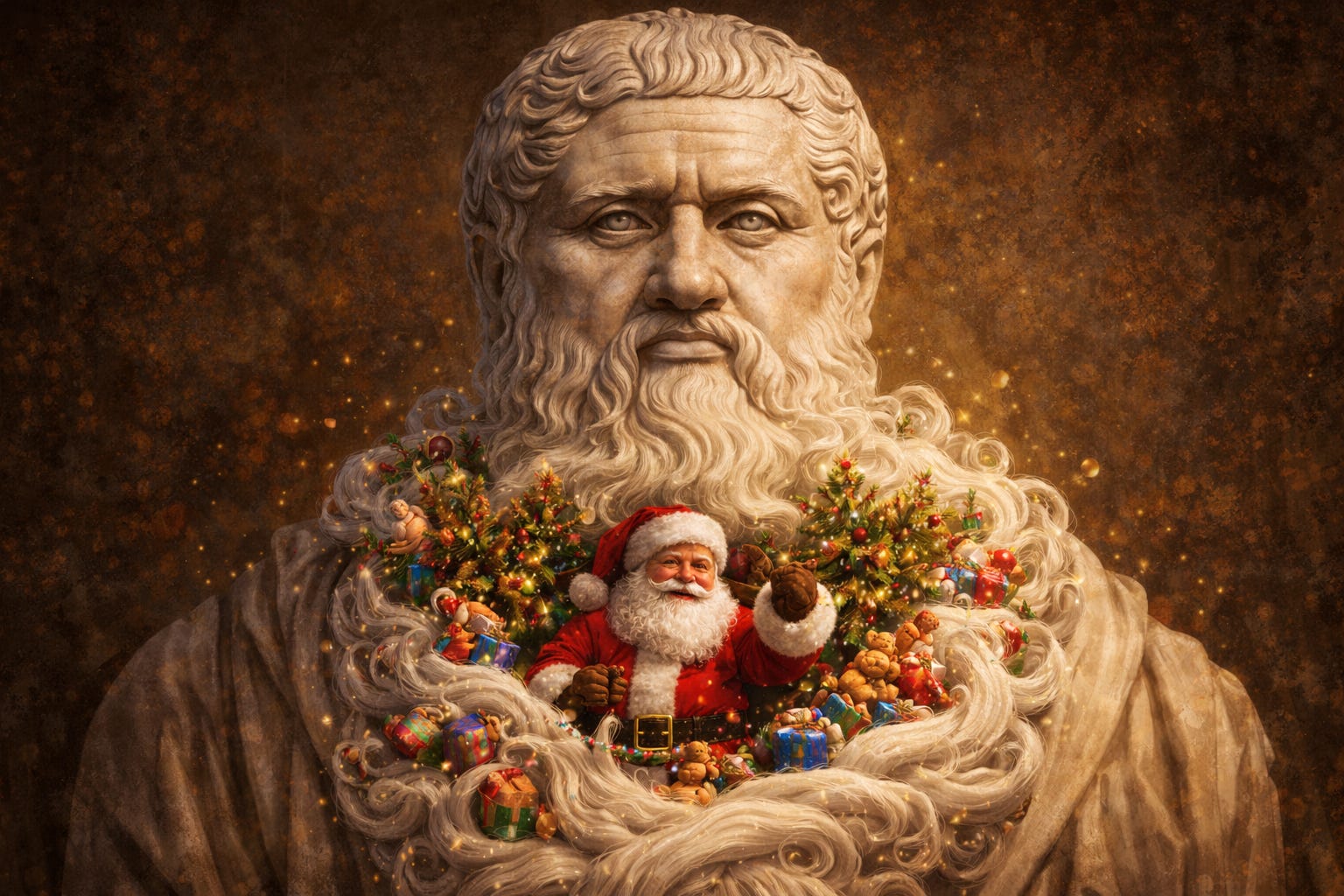
The British philosopher Bertrand Russell invented the theory of descriptions, which says that we can take any claim that seems to refer to nonexistent things and rephrase them in a way that avoids directly referring to anything by turning the name into a description. So, instead of saying “Santa does not exist” we could rephrase it as “There is nothing that delivers presents to every good child on Christmas Eve, lives at the North Pole, is fat, is jolly, etc.” We can summarize the description with a single predicate, call it: “Santaclausing.” Now, the claim “Santa does not exist” can be more accurately rephrased as: “There is no such thing that Santaclauses.” By rephrasing the claim this way, we have analyzed away the apparent reference to Santa with a description and revealed that the claim was never directly referring to Santa as an entity in the first place.
Such logical analyses are neat, precisely because they can help delete fake problems, like Plato’s Beard, that grow longstanding nonsense, like things that don’t exist. Logical analysis also shaves off the scratchy belief that existence is a property.
If existence were a feature or relation of things, then denying that something exists would only be denying that something has a property. And to deny that something doesn’t have a property, there must be something that doesn’t have that property. Thus, we would be running into the same paradox where, by denying something’s existence, we are apparently acknowledging its existence. Some philosophers, such as the Austrian philosopher Alexius Meinong, held that there are things, like Santa, they’re just non-actual beings. This view of existence not only makes existence a property, specifically, the property of actuality, which overpopulates reality with all logical possibilities, it also makes a distinction between being and existence where both possibilities and actualities have being but only actual things exist. However, notice that these beliefs arise only if we think we refer to something when we say that something doesn’t exist. But, by logically analyzing negative existence claims with Russell’s theory of descriptions, we can avoid all apparent references and deflate the motivations behind why we might be inclined to hold that existence is a property, or that there are nonexistent things, and so on.
So, if you ever find yourself told that “Nothing causes something” or “We can relate to things that don’t exist because they still have being” or “Something either has existence or doesn’t have existence” and other such humbug, don’t believe it. Just remember, there’s no such thing as Santa Claus.
REFERENCES
Alexius Meinong, “On the Theory of Objects,” in Realism and the Background of Phenomenology, ed. Roderick M. Chisholm (Glencoe, IL: Free Press, 1960), 76–117.
Plato. Sophist. Translated by David Horan.
Quine, Willard V. “On What There Is.” The Review of Metaphysics 2, no. 5 (1948): 21–38.
Russell, Bertrand. “On Denoting.” Mind 14, no. 56 (1905): 479–93.
Your example might be clearer if you defined what "something" means. Does logic exist? Is there some predicate that only logic can fulfill? What about Love, Truth, or Beauty? If they do exist, what distinguishes these ideas from Santa?
"We can relate to things which don't exist because they still have being" is a semantic nightmare. I can relate to Santa Claus (or perhaps the idea of Santa Claus).
The key is the subject/object distinction. santa exists as a concept- concepts are patterns in neurology. god, souls, ideas, math, shapes- all of it 'exists'- even things that dont exist exist.
the endeavour of honest philosophy then becomes how we are to discern what concepts in our heads have obvective correlates that arent just neurological.
in this sense, santa, gods, and souls, do not exist. even though they do as concepts. concepts arent hosted elsewhere, or, proof of a realm for all imagined beings, they're patterns in the neurology of the brain hosting the idea.